
Arrest Warrants in Starke County
An arrest warrant is a written court command that tells law enforcement to arrest a person and bring them before the court. Indiana Code 35-33-2 supplies the state framework. The warrant runs to the county sheriff. In Starke County, the court and the Clerk hold issuance and recordkeeping, while law enforcement takes service and custody. Probable cause drives the information path. It is the legal finding that lets a judge issue the warrant on a prosecutor's charging document. Starke County local rules add one more step. When a probable-cause affidavit is presented and a judge orders an arrest warrant, that judge sets bond, and serious Circuit Court bonds are set case by case. A public summary may omit the bond or later changes, so the current judicial order controls.
Starke County Arrest Warrant Paths
Indiana law offers two charging routes. An indictment is a grand-jury charging document, and it can support an arrest warrant without a separate probable-cause determination under this statute. An information comes from the prosecutor. There, the court must find probable cause first. Both routes end in a Starke County court order, not a Sheriff-created accusation.
| Charging Path | Court Finding | Starke Record Trail |
|---|---|---|
| Indictment | The indictment supports statutory issuance | Circuit Court filing and related orders |
| Information | Judge determines probable cause | Charging record, affidavit where public, and order |
The distinction can matter when you request an affidavit. It does not change the real task, which is confirming the current Starke County arrest warrant with the issuing court.
What a Starke County Arrest Warrant Contains
Indiana Code 35-33-2 lists the elements a warrant must contain. The public case summary is different. It can hold other docket details, but it is not the warrant itself. Starke County sources set no separate local warrant-number format, so treat a case identifier such as 75C01 as a court code, not a sample warrant number.
| Person | The person's name or a description sufficient to identify that person. |
|---|---|
| Offense | The charged offense for which the arrest is ordered. |
| Issue Details | The date and county of issuance. |
| Judicial Approval | The issuing judge's signature and title. |
| Command | Direction to arrest and bring the person before the court. |
| Bail | The bail amount, if the court has set one in the warrant. |
A MyCase result for a Starke County case can carry case style, court, type, filing date, status, charges, hearings, bond entries, and dated events. Fields vary by record.
Starke County Arrest Warrant Access
Starke County public access has hard limits. Indiana Administrative Rule 5 covers sealed and confidential cases, juvenile material, personal identifiers, investigative requests, and temporary exclusion in some criminal matters. An exclusion request can accompany an arrest-warrant request. The rule also ties how long that exclusion lasts to later events, including arrest and probable-cause findings.
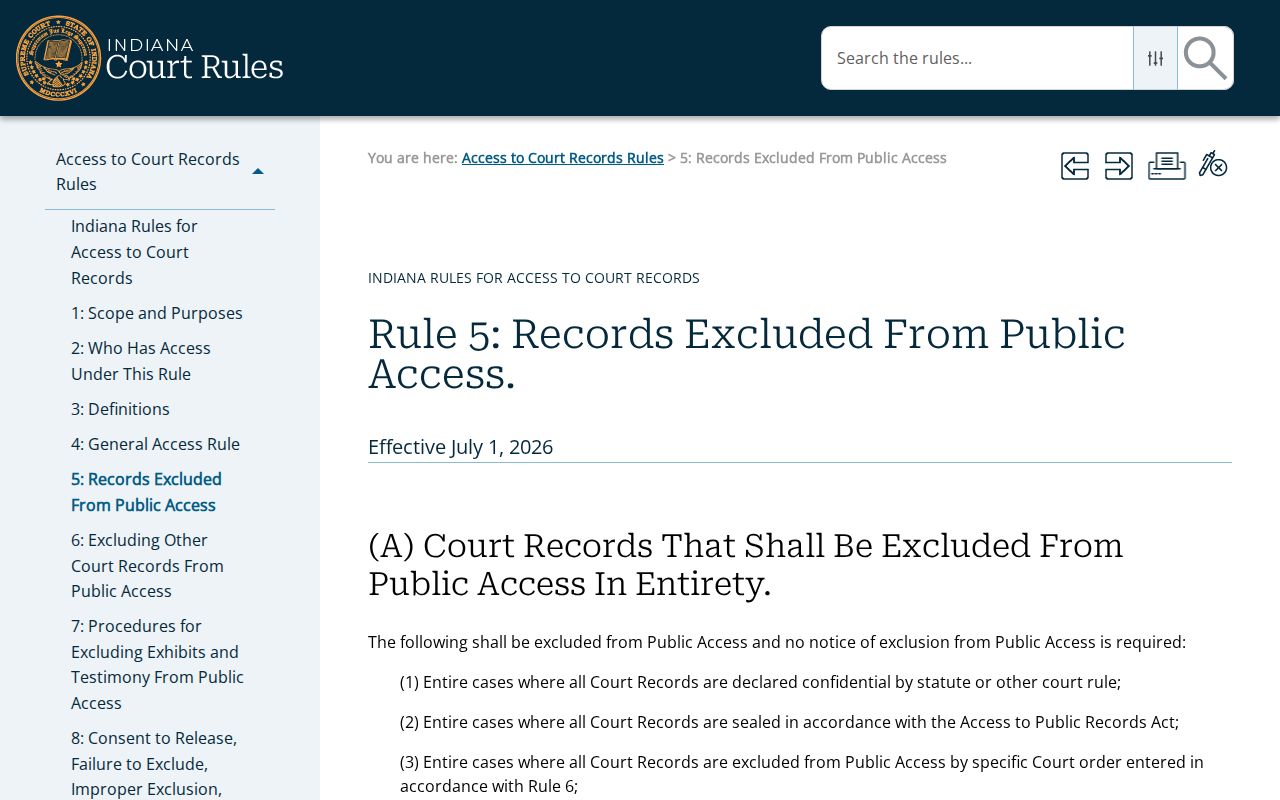
A file you cannot see proves nothing. An unserved Starke County arrest warrant, or its supporting affidavit, may be unavailable even though a court order exists. Juvenile records get extra protection. Ask the clerk for the releasable public portion. Respect the redactions instead of working around a lawful exclusion. Note: A public docket and a law-enforcement investigative file have different custodians and may give different access results.
How Starke County Arrest Warrants Are Served
The court issues the order. It is directed to the county sheriff. The Starke County Sheriff's mission page describes the office's duty to serve court process, attend court, operate the jail, and arrest felons. City police or town officers may also meet a person named in a valid warrant. So can an agency in another jurisdiction. The sheriff publishes no separate warrant unit or task-by-task service chart. Service brings the person into custody so the court process can continue. What follows depends on the case: booking, bond review, an initial court step, or another hold. The jail roster is not a warrant list. Prior booking data does not establish current warrant status either. Nor does the curated Most Wanted page cover every open Starke County warrant. The signed warrant and the live case record control.
Starke County Arrest Warrant Activity
The Sheriff's 2025 annual report gives local context without naming private people. The figures describe one calendar year of Starke County agency work. They are not a count of active warrants today. They also cannot show whether any person's order was served, recalled, sealed, or sent from another county.
Keep the categories straight. A search warrant authorizes a search, not the arrest of the named subject. Legal papers include more than warrants. An officer's warrant check is not a public roster entry, so a personal Starke County arrest warrant question still needs case-level confirmation.
Arrest Warrant vs Summons vs Bench Warrant
These papers call for different responses. An arrest warrant commands custody. A summons orders an appearance, not an arrest. A bench warrant usually follows a missed court act or a breach in an open case. Labels in a Starke County case summary can be brief, so read the filed order or ask the clerk what it means.
| Feature | Arrest Warrant | Summons | Bench Warrant |
|---|---|---|---|
| What it directs | Arrest and court presentation | Appearance on a stated date | Arrest after a missed duty or breach |
| Common basis | Criminal charging process | Notice to answer a filed matter | Existing case obligation |
| First response | Legal advice and direct confirmation | Attend or respond as ordered | Ask about recall, hearing, or bond |
Ignoring a summons brings added court consequences. A later failure-to-appear issue can follow, but a summons is still not a Starke County arrest warrant just because both relate to a criminal case.
Starke County Arrest Warrant Scams
Phone scammers love to borrow impressive court names. A caller may claim to represent a federal court and demand instant payment over an alleged warrant. Don't buy it. The U.S. District Court for Northern Indiana says plainly that the court never calls or emails anyone about warrants or traffic violations, never collects money, and never seeks personal financial data. That warning matters in Starke County too. Federal cases run through their own system, and a convincing court name on the line proves nothing about who is calling.
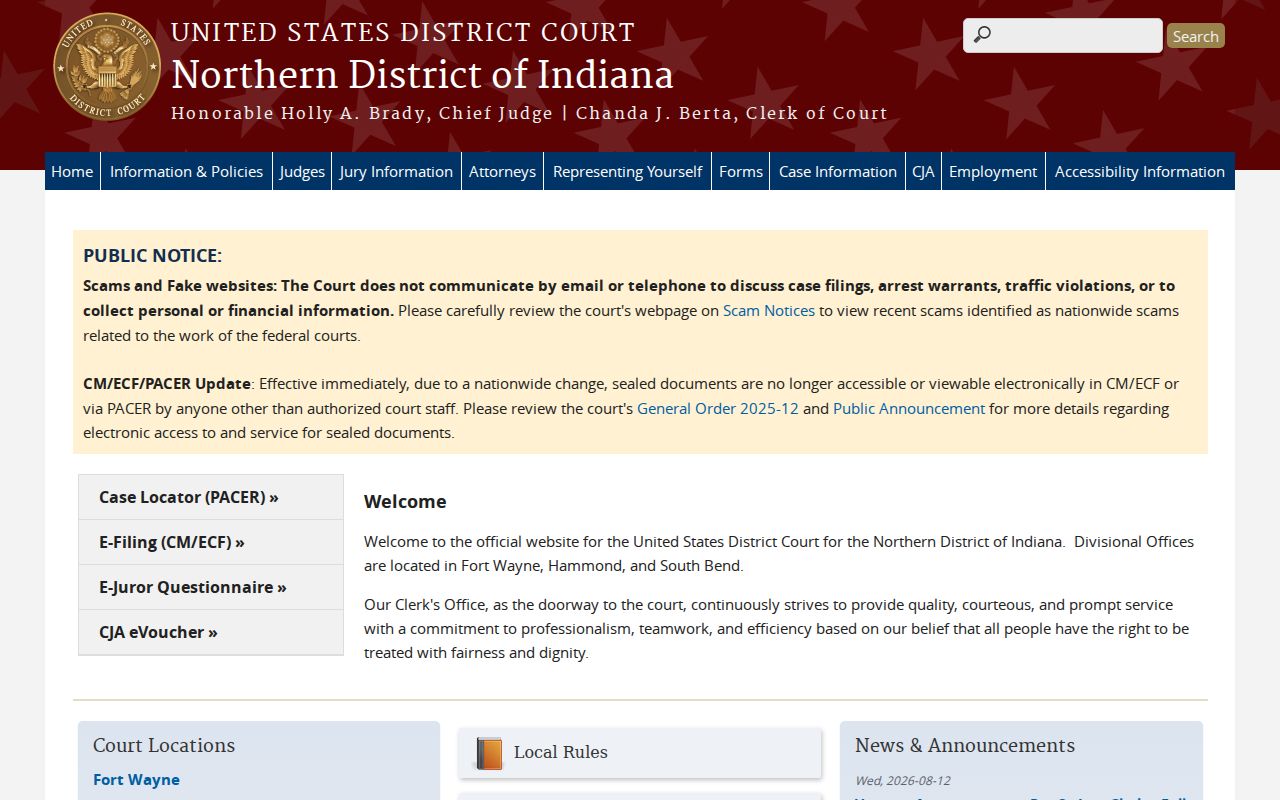
Demands for gift cards, cryptocurrency, a wire transfer, or remote access to your device are instant red flags. Hang up. Look up the court's phone number on your own and verify the claim before doing anything. A genuine Starke County arrest warrant gets resolved through the issuing court, never through an unsolicited demand or a payment link the caller hands you.
What to Do If There's a Warrant for You
Start with the court and the case. Pull the official MyCase record if it is public, then call the office shown on the docket. Starke Circuit Court answers at (574) 772-9146. The Starke County Clerk can be reached at (574) 772-9128, and Knox City Court runs its own city and misdemeanor track at (574) 772-3766. Leave the emergency line for real emergencies.
- Write down the case number, court code, charge, warrant marker, and any bond entry that is publicly visible.
- Ask the issuing court whether the warrant remains active and what appearance, motion, or bond step is required.
- Speak with an Indiana criminal-defense attorney about custody risk and a planned voluntary surrender.
- Follow the court's order, then confirm any recall, bond release, or docket update in writing.
Important: An active Starke County arrest warrant can result in custody; obtain legal advice before arranging an appearance or voluntary surrender.
A recall or quash motion asks a judge to act. It guarantees nothing. In Starke County, posting bond may win release, but it does not erase the charge or clear another jurisdiction's hold.
Starke County Arrest Warrant Checks
Starke County publishes no single public arrest warrant database. Indiana's official warrant FAQ explains that MyCase may show a warrant inside a public criminal case, though it is not a warrant search tool. No statewide site lists every Indiana arrest warrant. Treat MyCase as a clue. Then confirm with the issuing court. For an agency-held record, turn to the Sheriff's records service. Its Request for Production of Documents form accepts a written description and known case details by mail, fax, or email. The Starke County Sheriff sits at 5435 E. State Road 8, Knox, and the main line is (574) 772-3771. The form publishes no fee, identity rule, or timeline. Ask for releasable material and keep the response. Keep in mind that the court's docket, the Starke County Clerk's filed record, and the Sheriff's law-enforcement file are related but not interchangeable. A blank result in one channel means little. Before drawing any conclusion, check the court code, name spelling, dates, confidentiality limits, and filing timing. Note: The Sheriff posts no warrant-counter hours or after-hours surrender instructions, so call the court or counsel before traveling.